|
Digital
History>Virtual
Exhibits>Photograph
Album with Cyanotypes
Photograph
Album with Cyanotypes. Richard Riley, [ca. 1896-1903].
|
GLC
5140-03-13
|
Displayed
here are photographs from the Calhoun Industrial School
in Alabama.
Founded in 1892, Calhoun
was a freedmen's school devoted to industrial education.
Classes were offered in agriculture, arithmetic, basketry,
Bible study, carpentry, cobbling, cooking, English,
geography, mattress making, and sewing.
In addition, Calhoun
provided teacher training. Many of its courses were
taught by graduates of Virginia's Hampton Normal and
Agricultural Institute.
|
Calhoun was also a social
settlement in which blacks and whites lived and worked side
by side. The teachers, both black and white, assisted members
of the community, especially recently freed African Americans,
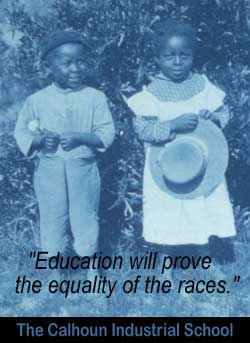
in gaining self-sufficiency. They believed that education
would improve ex-slaves' living conditions. Through the school,
they acted upon the words, "Education will prove the
equality of the races."
In 1913, Charlotte R. Thorn,
principal of the Calhoun School, wrote in her annual report:
"Calhoun's work and
influence cannot be restricted to its own community: it
must and does broaden out into county and state. The uplift
of the negro in the darkest section of the country is the
uplift of the whole country."
Learn
more about Calhoun School and Charlotte Thorn.
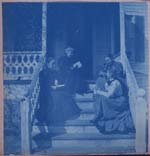
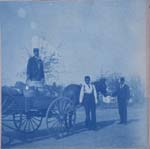
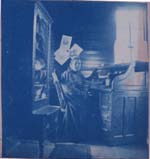
These photographs were taken
by Richard Riley. A member of the Camera Club at Hampton Institute,
Riley traveled to the Calhoun School to document its students,
teachers, and community.
These bright blue photographs
are known as cyanotypes. Cyanotypes were easily processed,
making them appealing to amateur photographers.
Learn more about cyanotypes.
Cyanotypes
in this Exhibit:
GLC 05140-02p9d |
|
GLC 05140-02p6e |
|
GLC 05140-02p7d |
|
