



















Biographical
Sidebar:
Albion W. Tourgée
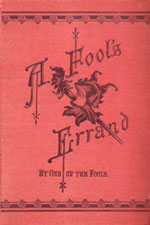
After 1877, Tourgée returned to the North, where he expressed his disappointment over the failure of Reconstruction in A Fool's Errand, a partly autobiographical account of a young carpetbagger's career. The novel is the classic fictional account of Reconstruction, describing the violence committed by the Ku Klux Klan and the North’s failure to ensure the legal and political rights of African Americans. The book became a bestseller, and Tourgée wrote several other popular novels.
 Learn
more about Tourgée's book,
Learn
more about Tourgée's book,
A Fool's Errand
 Previous Next

In 1896, Tourgée served without fee as attorney for Homer A. Plessy, who challenged a Louisiana law requiring the racial segregation of railroad cars. By denying blacks equal protection of the law, Tourgée argued, segregation violated the Fourteenth Amendment. Telling the court that “probably most white persons would prefer death to life in the United States as colored persons,” he said that the Constitution should be “color blind.”
In Plessy v. Ferguson, the Supreme Court upheld the law and announced the principle of "separate but equal." Not until 1954, in the Brown school segregation decision, did the Court adopt Tourgée's earlier reasoning.
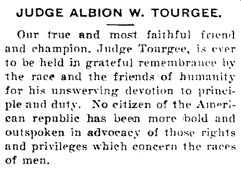
The Cleveland Gazette, 02/25/1899
Tourgée spent his last years serving as U. S. consul at Bordeaux, France, where he died.
